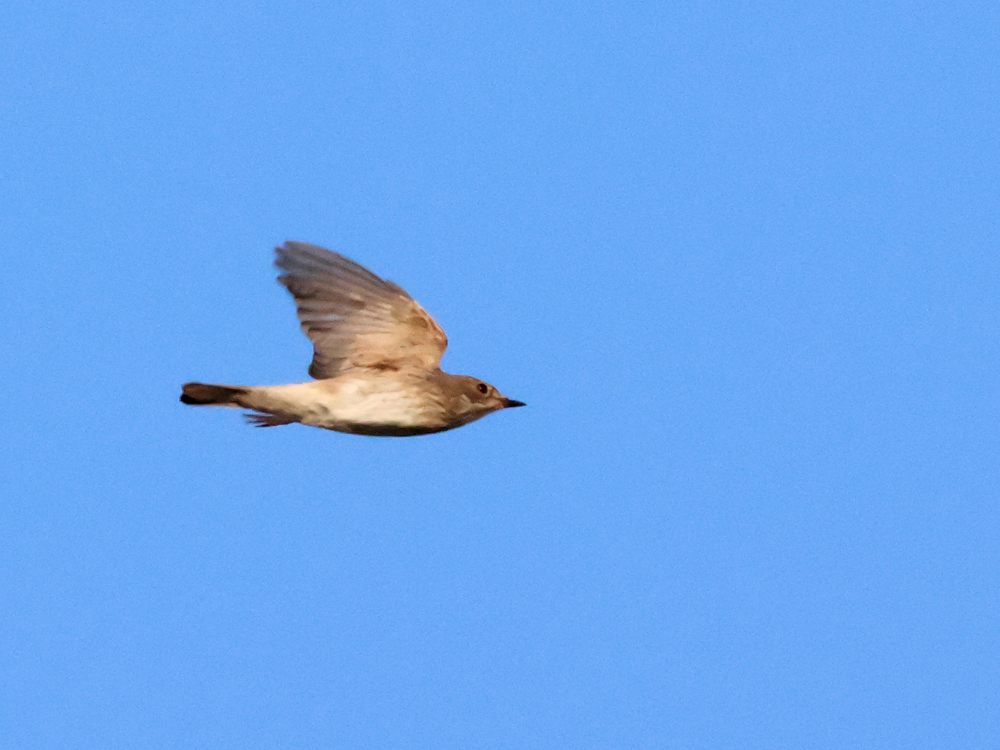
There was a distinct 'end of the migrant party' feel to today's proceedings - it was inevitable but it's been a lot of fun while it lasted; in fact there was also a hint of a changing of the seasons, with the singles of Grey Heron and Cuckoo at the Bill both surely post-breeding dispersers or departers. Incomers were represented by a few Swifts and Swallows, 7 Spotted Flycatchers, 6 Reed Warblers, 3 Willow Warblers and 2 each of Wheatear and Blackcap at the Bill, a few more of the same scattered about the centre of the island and 30 Ringed Plovers, 24 Sanderling, 8 Dunlin, 5 Turnstone, 4 Bar-tailed Godwits, 2 Grey Plovers and a Yellow Wagtail at Ferrybridge. The sea still had its moments, with 20 Common Scoter, 18 commic terns, 5 Sandwich Terns, 4 Mediterranean Gulls, 2 Black-headed Gulls and singles of Balearic Shearwater and Arctic Skua through off the Bill.
Of considerable local interest, today there was tangible evidence for the first time of the Kittiwakes at the Bill actually getting down to breeding: four active nests are visible from the viewpoint north of the QinetiQ fence - of these one certainly has an egg and we presume a second also does as one of the parents was sitting tight this evening; the adults are still only at the stage of standing around on the other two nests. This is the wider view of the cliff...
...these are the four active nests
...and here's a glimpse of an egg as one of the incubating birds has a shuffle.
We're not at all sad to see that the Raven pair involved in nabbing a huge number of Guillemot eggs from the seabird colony during recent breeding seasons seem to have failed to breed this year - one of the adults was hanging around the cliffs looking miserably menacing this evening but without a brood of miscreant youngsters to feed we're hoping he mightn't be quite such a nuisance this year...
Birding social media is full of tedious hyperbole but it isn't exaggerating to say that the migration happenings of the last fortnight really are without precedent at Portland - late May and early June sometimes provide the odd exceptional arrival of the likes of Spotted Flycatchers or Reed Warblers but for every day at this time of year to be producing the sort of numbers we've been logging indicates something truly strange is afoot this year. Today's heavy cloud cover and naggingly chilly northeastly at dawn dropped a bare minimum of 124 Swifts, 40 Spotted Flycatchers, 15 Reed Warblers, 5 Willow Warblers, 4 Blackcaps, 3 Whinchats, 2 Whitethroats, a Hobby, a Garden Warbler and a Chiffchaff at the Bill where we wouldn't mind betting the true totals of some of these arrivals would have been at least doubled given fuller coverage of hot-spots such as the West Cliffs. Awkward tide timings saw to it that Ferrybridge wasn't as well watched as it usually is, but 34 Ringed Plover, 13 Sanderling, 8 Dunlin, 6 Bar-tailed Godwits, 6 Turnstones, 3 Grey Plovers and 2 Redshank was a decent enough return from what coverage there was. The continuing Grey-headed Wagtail at Reap Lane attracted a steady succession of admirers but there were otherwise few reports from the middle of the island - was it watched or was the day's fall-out largely restricted to the Bill? A little bit of movement offshore included 24 Common Scoter, 5 Sandwich Terns, 2 Greenshank and a Balearic Shearwater through at the Bill.
Not that May has a shabby track record but June's always the month when the rare and scarce quotient ups a few notches and so it proved today, with a fly-by Golden Oriole at Top Fields/Sweethill, a Honey Buzzard through over Church Ope Cove and a Grey-headed Wagtail settled and showing nicely at Reap Lane. To confound expectations that an overcast morning would always outscore a cloudless one today's migrant tally was a considerable improvement on yesterday's, including excellent totals of 33 Spotted Flycatchers and 18 Reed Warblers scattered around the Bill and the centre of the island; the varied list of tag-alongs from the same area included 6 Willow Warblers, 4 Blackcaps, 3 Chiffchaffs and singles of Hobby, Turtle Dove, Whinchat, Redstart and Garden Warbler, whilst Ferrybridge chipped in with 68 Sanderling, 54 Ringed Plovers, 8 Turnstones, 6 Dunlin, 4 Bar-tailed Godwits, 2 Redshank and a Whinchat. Sea passage also continued, with 88 commic terns, 32 Common Scoter, 8 Sandwich Terns and a Balearic Shearwater through off the Bill.
Since it looked like the only day during a long run of very samey anticyclonic weather that would have any sort of cloud cover at dawn expectations were certainly on the positive side today. Although migrants did respond there was perhaps not quite as much on offer as had been hoped, with 57 Swifts and 25 Spotted Flycatchers at the Bill and 64 Sanderling at Ferrybridge accounting for the bulk of the numbers; a Turtle Dove at the Bill was the only oddity discovered. Variety came in the form of 6 Willow Warblers, 3 each of Reed Warbler and Blackcap, 2 Garden Warblers and singles of Whinchat and Chiffchaff at the Bill/Southwell, another Whinchat at Reap Lane and a Grey Plover at Ferrybridge. The sea always gave hope but, as with the land, never quite reached its full potential, with 46 Common Scoter, 26 commic terns, 3 Sandwich Terns and singles of Great Northern Diver, Balearic Shearwater, Shoveler and Arctic Skua the best of the morning tally at the Bill.
Still the migrants come: Whitethroat, Blackcap, Spotted Flycatcher & Reed Warbler already from the Obs mist-nets on a cloudier morning than of late pic.twitter.com/wFIjrL06AS
— Portland Bird Observatory (@PortlandBirdObs) May 31, 2023
lulworth skippers out at bottomcombe n over church ope cove. look as if they probably have been for a few days. adonis now on the wing at church ope cove too, again probably have been for a few days pic.twitter.com/ipZcG2RBGI
Relatively quiet today, although such is the ongoing momentum of late passage that even a quieter day had more on offer than we'd usually dare hope for on the penultimate day of May. The day's grounded migrant tally included 10 Spotted Flycatchers, 5 Willow Warblers, 2 Whinchats and a Reed Warbler at the Bill and 50 Ringed Plovers, 10 Sanderlings, 3 Dunlin, 2 Bar-tailed Godwits and 2 Turnstones at Ferrybridge; there looked to be very little visible passage to speak of although the first Sand Martin for a while was of interest at the Bill. The sea continued to be worth attention, with 41 commic terns, 13 Mediterranean Gulls and singles of Balearic Shearwater, Arctic Skua and Common Gull among the movers off the Bill.
Goodness knows when this is going to end but if we're seeing this many late migrants drop in when there's hardly been a cloud in the sky for the last week then there must be an awful lot of birds still on the move. Today suffered from severely reduced coverage but there was still 10 Spotted Flycatchers, 4 Whinchats, 3 Willow Warblers and singles of Yellow Wagtail, Wheatear, Sedge Warbler, Reed Warbler and Blackcap grounded at the Bill/Southwell, with a sample hour-long watch on West Cliffs producing 35 Swifts, 6 House Martins and 5 Swallows passing through overhead. Small waders are usually on the move far later than the passerines, so the 40 Ringed Plovers and 9 Sanderling amongst others at Ferrybridge weren't such a surprise; 8 Shelducks also dropped in there. The sea was hardly watched so the lone Balearic Shearwater, along with 14 Common Scoter and 7 commic terns, through off the Bill probably weren't a fair gauge of what may or may not have been on the move offshore.
Passage continues to tick over far more impressively than ought to be the case in late May, with a big increase in wader numbers and variety a notable feature today. Before getting overrun with holidaymakers and dogs the sandflats at Ferrybridge were busy, with totals that included 70 Ringed Plovers, 13 each of Dunlin and Sanderling, 4 each of Shelduck and Grey Plover, 3 Turnstones, 2 Shoveler and singles of Knot and Redshank; this richer vein of waterfowl and waders was reflected elsewhere, including 5 Mallards and singles of Whimbrel and Sanderling at the Bill. Tern passage also continued, with 160 more commic terns, along with 2 Balearic Shearwaters and a Great Skua, through off the Bill. In comparison, passerines were the poor relation although even their numbers far exceeded what would usually be expected at this juncture: 2 Hawfinches at the Obs were easily the highlight, with 9 Spotted Flycatchers, 8 Willow Warblers, 4 Whinchats, 2 each of Tree Pipit, Wheatear and Reed Warbler, and a Yellow Wagtail a more than respectable back-up list from the Bill/Southwell; a Hobby over Easton was the pick of a similar selection of lower totals of late migrants elsewhere.
The sight of mixed wader flocks was quite a novelty at Ferrybridge after a month-long barren spell...
More lovely, settled weather and more late migrants today. After yesterday's promising signs it was the sea that returned to the fore to provide the best of the day's action including a strong passage of terns: 790 commics made up the bulk ofthe numbers, but the addition of 25 Sandwich and a single Black, together with 58 Common Scoter and singles of Arctic Skua and Common Gull, made for a pretty decent late May watch at the Bill. Passerines still featured but there was certainly evidence of diminishing returns on that front, with 10 Willow Warblers, 8 Spotted Flycatchers and 3 each of Whinchat and Reed Warbler grounded at the Bill, where a Siskin and a handful of Swifts and hirundines trickled overhead. Nine Sanderling, 2 Bar-tailed Godwits and singles of Grey Plover and Whimbrel featured amongst the waders at Ferrybridge.
And back to a bit of catching up from earlier in the week: we'll start with our little voyage of discovery around a Cuckoo. This story begun when we came by a Cuckoo that had been found seemingly stunned under a window at a private house in the Verne Citadel. Despite being rather dopey - evidently it had crawled up into a bush where it had then sat motionless for at least eight hours! - it seemed otherwise OK so we kept it overnight to assess its condition in the morning.
The bird immediately stuck us as quite odd-looking: we imagined from the brown wash and barring around the head and chest that it must be a female but, although predominantly grey above, the upper wing coverts were plastered in brown notches and bars - a feature we couldn't remember having seen on a spring Cuckoo before but presumed must be related to some sort of immaturity; however, the plumage all seemed to be fresh and of the same generation, with no sign of any moult discontinuities or suspensions that might indicate it was in first-summer plumage. Seeking help from our betters we had a scan through the standard field guides and, perplexingly, discovered none of them depicted a bird that looked anything like this - basically, they showed female as either plain grey above or rusty with dark bars in hepatic morph individuals. It was eventually the ever-dependable detailed plumage description in BWP that came up with the answer: a proportion of adult females do in fact show this feature to a greater or lesser extent.
The next issue to dwell on was whether it was definitely a Common Cuckoo. Oriental Cuckoo is always at the back of our mind with late spring or late autumn occurrences but few if any of these sightings actually afford the sort of views required to tackle this massively difficult ID issue - however, a bird in the hand is a different kettle of fish! The essential reference for a bird like this is Identification of Oriental Cuckoo and Common Cuckoo based on primary pattern from Dutch Birding - in our bird both the number of white bars on the outer three primaries and the extent of the barred area on each feather is bang on for Common Cuckoo and outside the range for Oriental:
Just for comparison purposes with our bird (above), we hope the folk at Dutch Birding won't mind us lifting this photo and caption from the article that relates to the Finnish Oriental Cuckoo in 2015 and shows really well the difference in primary pattern (and, for example, the extent of barring on the underwing coverts):
Very fair, almost cloudless conditions seem to be setting in which is a shame as there are clearly still late migrants on the move and the chances of them dropping look to be diminishing. Today's Bill tally included 17 Spotted Flycatchers, 7 each of Whinchat and Willow Warbler, 5 Black-headed Gulls, 2 Reed Warblers and singles of Turnstone, Tree Pipit, Wheatear, Redstart and Blackcap, with a handful of Swifts and hirundines still arriving overhead; a second singing Corn Bunting there was additional to the long-stayer still present. Spotted Flycatchers in particular were spread quite liberally elsewhere, whilst an Osprey passed over at Portland Harbour; Ferrybridge waders included 26 Ringed Plovers, 8 Dunlin, 4 each of Bar-tailed Godwit and Sanderling, 3 Turnstones and a Whimbrel. A surprise offshore was a surge in commic terns, with 288 through off the Bill; sea passage was otherwise almost non-existent although Manx Shearwaters were again milling around offshore in numbers.
The migrants keep coming, with today's grounded tally at the Bill including 10 each of Willow Warbler and Spotted Flycatcher, 8 Whinchats, 7 Reed Warblers, 4 Yellow Wagtails, 2 or 3 each of Sedge Warbler, Garden Warbler, Blackcap and Lesser Whitethroat, and singles of Turtle Dove and Mistle Thrush; overhead, Swallows picked up a little but Swifts and House Martins hardly featured. The sea provided 3 Arctic Skuas but precious little else on the move.
Another day with passerine migrants in far greater numbers and variety than would be expected on this date - and it was all the more surprising that they should arrive on a day of balmy sunshine and hardly a waft of a breeze. The Bill area was well covered and provided the bulk of the numbers that included 20 Willow Warblers, 15 Spotted Flycatchers, 10 Whinchats, 5 Reed Warblers, 3 each of Sedge Warbler, Whitethroat, Blackcap and Chiffchaff, and singles of Hobby, Yellow-legged Gull, Wheatear and Grasshopper Warbler; a few Swifts and hirundines were also still on the move overhead. Other areas weren't so well covered but a scatter of Spotted Flycatchers in particular was evident everywhere and a Cuckoo was at the Verne Citadel. Wader variety improved, with 20 Dunlin, 14 Ringed Plovers, 9 Sanderling, 2 Grey Plover, 2 Knots and a Turnstone grounded at Ferrybridge and 12 Bar-tailed Godwits and a Whimbrel passing overhead there. Manx Shearwaters were again ever-present off the Bill although in lower numbers than yesterday, with 18 Common Scoter, 2 Common Gulls, 2 Sandwich Terns, a Balearic Shearwater, an Arctic Skua and a Mediterranean Gull also through there.
We ended up with so many photos/videos/recordings from today that we couldn't sort them all out before hitting a late night wall of tiredness/befuddlement whilst trying to work out how to age and sex Knots! - they'll have to follow in the next few days.
Today was always going to struggle to live up to yesterday's happenings and so it proved - although in all fairness there was far more about than would usually be expected in late May. The day's perfectly respectable migrant totals at the Bill included 107 Swifts, 28 House Martins, 15 Spotted Flycatchers, 8 Blackcaps, 6 Willow Warblers, 5 Reed Warblers, 3 Wheatears, 2 Whinchats, 2 Chiffchaffs, a Blue-headed Wagtail and a Garden Warbler, with Ferrybridge chipping in with 30 Dunlin, 24 Ringed Plover, 4 Turnstones, 3 Sanderlings and singles of Grey Plover, Bar-tailed Godwit and Common Sandpiper. The sea merited attention as well, with the year's first Black Tern through off the Bill quite a highlight in this day and age of their extreme paucity in these waters; further totals from there of c500 Manx Shearwaters, 70 commic terns, c25 Lesser Black-backed Gulls, 3 Balearic Shearwaters, 3 Common Scoter and a Great Skua marked it out as a pretty decent watch given the benign conditions.
Pine Hawkmoths becoming more regular in the garden, maybe due to Gary’s huge pine tree by the bottom of the garden and the wild Honeysuckle in our copse pic.twitter.com/USL0RwDxJH
With a stiff headwind and intermittent cloud lapping the coast after a very clear night the stage was always set for a bit of late movement today but the logjam of migrants delayed by the hitherto cool spring - and perhaps also the recent turbulent conditions further south? - was clearly greater than we'd imagined and the blistering migration event that unfolded as dawn broke caught everyone out. Big Spotted Flycatchers movements aren't frequent events here so the spectacle of 282 through at the Bill - a total only exceeded by the likely once in a lifetime tsunami of 1000 on 1st June 2013 - was lapped up by the few observers in the field; Swifts staged a strong showing with 502 through that, together with the c100 each of Swallow and House Martin and other odds and ends including 29 Wood Pigeons, a few Tree Pipits and Yellow Wagtails and a lone Siskin, ensured that for the first few hours of the day overflying migrants were a constant feature. In many respects events on the ground were overshadowed by what was going on overhead and almost escaped attention were it not for the Obs garden and Culverwell mist-nets tapping into a constant flow of tardy warblers that included 50 Willow Warblers, 25 Blackcaps, 15 Reed Warblers, 10 Whitethroats and a few Sedge Warblers, Garden Warblers and Chiffchaffs. The sea was well-watched but produced little more than 37 Common Scoter and 4 Great Northern Divers. Wader numbers remained less than impressive but did include the year's first Little Stint at Ferrybridge.
Whilst our occasional huge falls of warblers and other terrestrial trans-Saharan migrants always includes a component of visible movement - particularly along West Cliffs - this is usually confined to low-level 'bush-hopping' so to be able to watch quantities of Spotted Flycatchers passing straight through at tree-top height is always a compelling spectacle...