13th June

Portland Bill
Manx Shearwater 120etc
Balearic Shearwater 1etc
Little Egret 2
Common Scoter 5w
Black-headed Gull 3
Sandwich Tern 4w
Puffin 1etc
Swift 17
Swallow 1n
Chiffchaff 1
Willow Warbler 1

Ferrybridge
Black Swan 3
Dunlin 24
Sanderling 10
Bar-tailed Godwit 1
Redshank 1
Redwing 2s

The Ferrybridge Black Swans were presumably wandering down the Fleet from Abbotsbury - we're sure the guys there will correct us if this isn't right but we think these are some of the four birds that first arrived in the area last July when, rather bizarrely, they pitched up on the shore at the tip of the Bill; you'd have thought that somebody would have had an inkling about where they originated from but our enquires at the time drew a blank © Debby Saunders:


After only being seen on the wing for the first time yesterday Marbled Whites were suddenly everywhere today making the most of what, for Portland, was a really scorching 24C day © Roy Norris:

12th June

Portland Bill
Manx Shearwater 40etc
Balearic Shearwater 2etc
Common Scoter 44e 2w
Black-headed Gull 7e 5w
Mediterranean Gull 10etc
Sandwich Tern 2e
Swift 17
Reed Warbler 2
Chiffchaff 1

Southwell
Serin 1 singing in a private garden

Ferrybridge 
Grey Plover 1
Bar-tailed Godwit 1

Silver-studded Blue at Tout Quarry this evening © Mark Cutts

11th June

The novelty of some rainfall - admittedly not much but the first for three weeks or so - did no particular favours and, at least for passerines, it remained very quiet. Singles of Reed Warbler, Chiffchaff and Willow Warbler were new at the Bill, whilst the wader tally at Ferrybridge was relatively static at 19 Dunlin, 8 Ringed Plovers and singles of Grey Plover, Sanderling, Bar-tailed Godwit and Redshank. The sea wasn't well watched, with a lone Balearic Shearwater off the Bill the only report of note.

10th June

The promised change in the weather saw far more cloud in the sky and the threat - even if nothing ever materialised - of thundery rain rarely far away. Waders have provided a lot of the interest through the week so it shouldn't have been any surprise when Ferrybridge turned up the bird of the in the form of the island's sixth record of Red-necked Phalarope; 8 Sanderling and singles of Knot and Bar-tailed Godwit were amongst the relatively few other waders there. In the commoner migrant line the day's surprise happening was another decent passage offshore, with 290 commic terns, 112 Common Scoter, 53 Manx Shearwaters, 14 Sandwich Terns, 11 Lesser Black-backed Gulls, 6 Oystercatchers, 5 Balearic Shearwaters, 5 Black-headed Gulls, 3 Gadwall, 2 Whimbrel, 2 Little Terns and singles of Arctic Skua and Black Tern through off the Bill. A small likely weather-related movement of Swifts was evident over the Bill, where a Dunlin also passed over but the only obvious new passerine on the ground was a lone Reed Warbler.

Not surprisingly, Red-necked Phalarope is a pretty high value rarity at Portland. There are only two previous records for Ferrybridge - in May 1972 and April 2002, whilst the other three records are all of October seawatch sightings: in 1960 and 1980 off the Bill and in 1963 off Chesil © Martin Cade:


9th June

The stiff northeasterly that's been blowing so relentlessly for what seems like an age has become such an inevitability that we've not even been mentioning it lately - by the sound of the forecast we might soon be losing it but it was still blowing hard this morning and make early fieldwork less than enjoyable. The only obvious new arrivals at the Bill were a Willow Warbler on the ground and a few Swifts and hirundines overhead; lingering singles of Reed Warbler and Chiffchaff were also still present there. The Ferrybridge wader tally continued to dwindle, with Ringed Plover, Sanderling and Dunlin all only just scraping into double figures. Four Balearic Shearwaters were the best of the thin selection offshore at the Bill.

Moth immigration has dropped away to almost nothing but Red Admirals have been on the move in good numbers for several days, with visible migration very conspicuous in tandem with a big increase in numbers on the ground...


...at a local level another immigrant was this Black-tailed Skimmer lingering around the pond in the Crown Estate Field © Martin Cade:


8th June

The lean times are really beginning to bite with even the hitherto reliable supply of waders dwindling as they head north. The migrant tally on the ground at the Bill consisted of just 2 Reed Warblers, although overhead 2 arriving Hobbys were a surprise amongst the handful of incoming Swifts and hirundines. Waders did fare better although only Ringed Plover managed a double-figure total at Ferrybridge where 2 Knot and a Grey Plover were the best of the rest. Two Sanderlings and Grey Plover also passed through off the Bill, along with a decent total for so late of 65 Common Scoter; 2 Arctic Skuas and a lone Balearic Shearwater also made the log and the first evening movement of Manx Shearwaters for a few days saw just shy of 100 pass in a sample hour.

7th June

With so far to go the arctic waders are always on the move that bit later than the passerine migrants and it was Ferrybridge that came up with both the variety and numbers again today. A Curlew Sandpiper was the pick of the bunch, but a nice back-up cast of 45 Sanderlings, 30 Ringed Plovers, 8 Dunlin, 6 Turnstone, 3 each of Bar-tailed Godwit and Knot, and 2 each of Grey Plover and Whimbrel - along with burgeoning numbers of Mediterranean Gulls - represented a nice early morning return from the sandflats; nearby off Chesil a late Red-throated Diver was also of note. The lingering Serin popped up twice today, first at the Obs and later at Sweethill, whilst odds and ends by way of late passerine migrants scattered between the Bill and Southwell included 2 each of Reed Warbler, Chiffchaff, Willow Warbler and Spotted Flycatcher, and a single Yellow Wagtail. A lone passing Arctic Skua was the best from the sea at the Bill.

A few from Ferrybridge this morning; the Curlew Sandpiper © Debby Saunders (top) and Pete Saunders (bottom)...


some of the Knots © Debby Saunders (top) and Pete Saunders (bottom two)...


...and the two Whimbrel © Pete Saunders:


And the Serin when it dropped in at Sweethill © Pete Saunders:


6th June

Today's excitement was over within an hour of first light when the lingering Serin made the last of several fly-arounds of the Obs garden. Subsequently, dogged pursuit of something better drew a blank and also revealed a dearth of migrants bar a fair few waders still passing through at Ferrybridge. The waders accounted for pretty well all the day's numbers, with 37 Ringed Plovers, 23 Sanderling, 12 Turnstones, 9 Dunlin, 3 Bar-tailed Godwits and a Knot representing a fair tally for this late in the season; passerines arrivals were very few and far between, with 3 Reed Warblers and 2 Blackcaps the only obvious newcomers on the ground at the Bill. A smattering of interest on the sea included 21 Common Scoter, 10 commic terns and 4 Sandwich Terns on the move off the Bill.

The majority of first-summer Mediterranean Gulls don't get anywhere near as hooded as this bird at Ferrybridge today...


...nicely-plumaged Turnstones also remain at daily sight there © Pete Saunders:


5th June

The gradual slip back into normal June mode continued, with three appearances by the Serin at the Obs -  where there was also an unseasonable Black Redstart - the day's highlight. The migrant tally at the Bill included a handful of arriving Swifts and hirundines, 4 Reed Warblers, 2 Chiffchaffs, 2 Spotted Flycatchers and singles of Hobby, Dunlin, Wheatear and Willow Warbler; Ferrybridge was busier, including 28 Sanderling, 11 Turnstone, 8 Dunlin, 6 Bar-tailed Godwits, 3 Grey Plovers, 2 Shoveler and 2 Knot. Three passing Arctic Skuas and the likely lingering Balearic Shearwater off the Bill were the best from the sea, with 10 Sandwich Terns, 2 Whimbrel and a Sanderling also through there and 2 Knot through off Chesil.

Arctic-bound waders continue to pass through at Ferrybridge with Sanderlings considerably better represented than Dunlins just recently...


...several Bar-tailed Godwits have also taken up temporary residence there and, since the bulk of their passage through this area took place getting on for seven weeks ago, we wouldn't be surprised if these birds are giving a breeding attempt a miss this year © Pete Saunders:


Also at Ferrybridge, pairs of Shoveler have dropped in twice just recently; given it's a peculiar time of year for them to be moving about it's tempting to wonder if it's the same pair on each occasion even though we did see a lone drake passing the Bill last week - perhaps there's just something odd going on with Shovelers right now? © Pete Saunders:


The Kittiwakes at the Bill continue to be a popular attraction - some of last year's youngsters are now beginning to look pretty threadbare © Roy Norris:


Lulworth Skippers have been on the wing for a few days now although they're not yet particularly numerous © Roy Norris female (top) and Eleanor Page male (bottom):


4th June

No doubt not for the last time a Serin saved the day today when it pitched up for a couple of minutes at the Obs. With a cloudless sky and blazing sunshine the order of the day migrant numbers continued to fall: a few waders included more than 40 Sanderling still amongst the variety at Ferrybridge and 2 Turnstones at the Bill, but the passerine tally at the latter consisted of just 4 Spotted Flycatchers, 3 Willow Warblers, 2 Whinchats and singles of Wheatear, Reed Warbler and Chiffchaff. The sea was hardly watched, with 21 Common Scoter, 3 Sandwich Terns and a Balearic Shearwater the only worthwhile sightings from the Bill.

Serins have been tricky to catch up with this spring and today's bird was no exception: it appeared unannounced, called continually for the two minutes or so that it was settled in a treetop at the Obs and then launched into the sky never to be seen again. Where do all the Serins that drop in like this at the Obs end up? Nowhere else on Portland, let alone elsewhere in Dorset, records Serins at anything remotely like the frequency with which they turn up here - surely they can't all just be crossing the Channel for fun or for something to do for a couple of hours and then immediately re-crossing it back to France © Martin Cade:
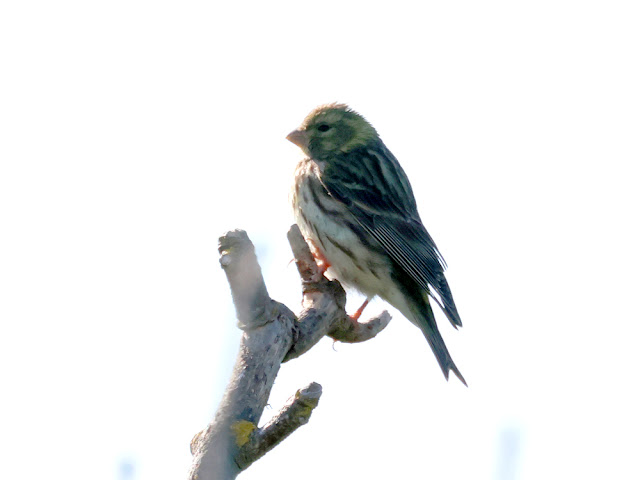


Today's Serin also reminded us of another that was one of the many things that we got late with a couple of weeks ago when the sudden surge in migrants halted any desire we might have had to spend time looking at a screen. This bird was heard on the afternoon of the big Spot Fly surge on 22nd May - it was singing strongly from a leafy tree in the Obs front garden but, since it remained completely invisible until it must have slipped away, there was reluctance on the part of the observers to fully claim it; fortunately, a phone recording of it clinches the ID beyond doubt © Jodie Henderson:


Despite a huge full moon and relatively breezy conditions moth numbers and variety seem finally to be picking up: the first 'local special' of the year - this Four Spotted - was trapped overnight at the Obs...


...where quite a few of the summer 'pretties' like this freshly emerging Scarlet Tiger are also now appearing...


...however, immigrant interest is almost non-existent with this Delicate from last night the only minor oddity in recent days © Martin Cade:

3rd June

There was a distinct 'end of the migrant party' feel to today's proceedings - it was inevitable but it's been a lot of fun while it lasted; in fact there was also a hint of a changing of the seasons, with the singles of Grey Heron and Cuckoo at the Bill both surely post-breeding dispersers or departers. Incomers were represented by a few Swifts and Swallows, 7 Spotted Flycatchers, 6 Reed Warblers, 3 Willow Warblers and 2 each of Wheatear and Blackcap at the Bill, a few more of the same scattered about the centre of the island and 30 Ringed Plovers, 24 Sanderling, 8 Dunlin, 5 Turnstone, 4 Bar-tailed Godwits, 2 Grey Plovers and a Yellow Wagtail at Ferrybridge. The sea still had its moments, with 20 Common Scoter, 18 commic terns, 5 Sandwich Terns, 4 Mediterranean Gulls, 2 Black-headed Gulls and singles of Balearic Shearwater and Arctic Skua through off the Bill.

Of considerable local interest, today there was tangible evidence for the first time of the Kittiwakes at the Bill actually getting down to breeding: four active nests are visible from the viewpoint north of the QinetiQ fence - of these one certainly has an egg and we presume a second also does as one of the parents was sitting tight this evening; the adults are still only at the stage of standing around on the other two nests. This is the wider view of the cliff...


...these are the four active nests


...and here's a glimpse of an egg as one of the incubating birds has a shuffle.


We're not at all sad to see that the Raven pair involved in nabbing a huge number of Guillemot eggs from the seabird colony during recent breeding seasons seem to have failed to breed this year - one of the adults was hanging around the cliffs looking miserably menacing this evening but without a brood of miscreant youngsters to feed we're hoping he mightn't be quite such a nuisance this year...


...in fact the Guillemots looked to be so chilled about the situation this evening that some of them were leaving their eggs completely unattended for long periods © Martin Cade:


This evening's moonrise - evidently the Strawberry Full Moon in US parlance - was especially stupendous © Joe Stockwell:

2nd June

Birding social media is full of tedious hyperbole but it isn't exaggerating to say that the migration happenings of the last fortnight really are without precedent at Portland - late May and early June sometimes provide the odd exceptional arrival of the likes of Spotted Flycatchers or Reed Warblers but for every day at this time of year to be producing the sort of numbers we've been logging indicates something truly strange is afoot this year. Today's heavy cloud cover and naggingly chilly northeastly at dawn dropped a bare minimum of 124 Swifts, 40 Spotted Flycatchers, 15 Reed Warblers, 5 Willow Warblers, 4 Blackcaps, 3 Whinchats, 2 Whitethroats, a Hobby, a Garden Warbler and a Chiffchaff at the Bill where we wouldn't mind betting the true totals of some of these arrivals would have been at least doubled given fuller coverage of hot-spots such as the West Cliffs. Awkward tide timings saw to it that Ferrybridge wasn't as well watched as it usually is, but 34 Ringed Plover, 13 Sanderling, 8 Dunlin, 6 Bar-tailed Godwits, 6 Turnstones, 3 Grey Plovers and 2 Redshank was a decent enough return from what coverage there was. The continuing Grey-headed Wagtail at Reap Lane attracted a steady succession of admirers but there were otherwise few reports from the middle of the island - was it watched or was the day's fall-out largely restricted to the Bill? A little bit of movement offshore included 24 Common Scoter, 5 Sandwich Terns, 2 Greenshank and a Balearic Shearwater through at the Bill.

It was a lot easier to appreciate some of the subtler features of the Grey-headed Wagtail in this morning's flatter light © Pete Saunders (top) and Simon Craft (bottom):


The birding can be really difficult at this time of year now that the trees are in full leaf. Some things like Spotted Flycatchers are a doddle...


...but others like Willow Warbler that were so straightforward in the bare branches just a few weeks ago are suddenly really hard to pin down...


...and you may as well forget about Reed Warblers - they can be in full song just a few metres away...


...but you try and get any sort of meaningful view of them!


We're wondering right now about the extent to which our unprecedented arrivals of migrants might be related to the ongoing unseasonable cold weather in Scandinavia and the Baltic States - are some of our arrivals being deflected from there?...are some of our lingerers perhaps even aware in some way of what's afoot there? In the balminess that followed this morning's chill it was noticeable that migrants presumably eventually headed in that direction weren't exactly full of the joys of Zugunruhe! © Martin Cade:


1st June

Not that May has a shabby track record but June's always the month when the rare and scarce quotient ups a few notches and so it proved today, with a fly-by Golden Oriole at Top Fields/Sweethill, a Honey Buzzard through over Church Ope Cove and a Grey-headed Wagtail settled and showing nicely at Reap Lane. To confound expectations that an overcast morning would always outscore a cloudless one today's migrant tally was a considerable improvement on yesterday's, including excellent totals of 33 Spotted Flycatchers and 18 Reed Warblers scattered around the Bill and the centre of the island; the varied list of tag-alongs from the same area included 6 Willow Warblers, 4 Blackcaps, 3 Chiffchaffs and singles of Hobby, Turtle Dove, Whinchat, Redstart and Garden Warbler, whilst Ferrybridge chipped in with 68 Sanderling, 54 Ringed Plovers, 8 Turnstones, 6 Dunlin, 4 Bar-tailed Godwits, 2 Redshank and a Whinchat. Sea passage also continued, with 88 commic terns, 32 Common Scoter, 8 Sandwich Terns and a Balearic Shearwater through off the Bill.

Phil Cheeseman's a very assiduous recent addition to the local birding community and it was only a few days ago that in conversation with him we mentioned that it's always worth paying close attention to any late spring Yellow Wagtails he comes across; with that in mind, we were aghast this afternoon when Phil reported to us that he'd found a very dark-headed wagtail at Reap Lane but that it'd flown off shortly after discovery and been completely lost to view. The boc photos were indeed gripping and having been taken in the brutal midday light conveyed the impression of an almost black-head bird that certainly needed hunting for; although the follow-up emailed photos had allowed the identification as a Grey-headed Wagtail to be firmed up it was still a relief when, after a lot of hunting, Nick Hopper discovered the bird right back where it had first been seen - and where it was to remain for the rest of the day. As far as we're aware this is only the third record for the island, the others being of singles at the Bill on 24th September 1977 and at Reap Lane on 20th May 2011 © Phil Cheeseman (top), Nick Hopper (bottom) and Martin Cade (video):


The Church Ope Cove Honey Buzzard © Eleanor Page:


And a Redstart to add to the recent migrant bonanza © Martin Cade/Eleanor Page: